11 After The Storm
Leon sits at his desk, looking at the photos1 from yesterday’s workshop. The wall is crowded with events, questions, sketches, and small clusters of notes. Some parts look orderly. Others are a mess. He zooms in on a section, reads a note, then zooms out again.
He is trying to put his thoughts into a form that makes sense. Not a workshop report. Claire doesn’t need a list of everything the team did during the day. She wants to know whether the experiment is moving in the right direction, and Leon wants to understand that himself.
The morning started slowly. Nobody in the team has done Event Storming together before, and the first few minutes felt a little awkward. But once the events began to accumulate, people started connecting things. Questions lead to more questions. Sarah, the shelter director, became part of the discovery rather than someone who simply answers what the team asks.
That is one of the things Leon keeps thinking about. The team didn’t just collect information from Sarah. They explored the domain with her. And sometimes they discovered that what they think they know is wrong. The microchip is a good example. Caramelo’s story gave them the impression that the chip is checked during the medical examination. Sarah explained that they scan it immediately when an animal arrives. A small correction, perhaps, but it changes the sequence the team had in mind.
In the afternoon, Kim took the group from the events to screens and user journeys. Leon expected the change of perspective to be useful, but he didn’t expect it to reveal another part of the domain they haven’t considered. The Occupancy Board did exactly that. What initially looked like a screen for displaying animals turned into a discussion about kennels, animal locations, availability, and the information shelter staff need to decide where an animal can stay.
The day leaves Leon with a strange combination of excitement and uncertainty. They made more progress than he expected, but the more they discovered, the more he saw how much they still don’t know.
He closes the photos and heads to Claire’s office.
11.1 Reporting back to Claire
Claire looks up when he enters.
“So, how was the storm?”
Leon smiles.
“Better than I expected. And more interesting than I expected, too.”
“That’s a promising start. What makes you say that?”
Leon takes a seat. He has a few points in mind, but he doesn’t want to turn the conversation into a presentation.
“The engagement, mainly. I wasn’t sure how the team would react. None of us has worked this way together before. The first part was a little slow, but once we got going, everyone contributed. And Sarah was not just answering questions. She started exploring the process with us.”
“What is different about that compared with your usual requirements workshops?”
Leon thinks for a moment.
“Usually, we arrive with a pretty good idea of what we want to ask. We collect the answers, Kim documents the requirements, and then we work out what needs to be built. Yesterday, we didn’t really know what we are looking for yet. We started with a simple question about what happens when an animal arrives, and the next question often came from something someone else noticed.”
“And that works?”
“Surprisingly well. We uncovered things we didn’t know, and we didn’t have to pretend that we have an answer. We marked the questions and kept going. Otherwise, we could have spent half the morning discussing one detail.”
“You mean the Hot Spots?”
“Exactly. It gave us a way to keep track of the open questions without losing the bigger picture.”
Claire leans back.
“You sound impressed by the technique. But what about the result? Do you understand the animal intake process better now?”
“Definitely. We have a much better overview than I expected after just one morning. And we have it together. That’s probably the part that surprises me most.”
“Together?”
“Yes. Sarah knows the shelter’s work, of course. But she doesn’t necessarily think about it in the same way we do. And we don’t all look at it from the same angle either. Kim noticed things about the user journey. Mina spoted gaps in the process. Chris asked questions about what happens behind the scenes. I think we got a more complete picture because everyone was looking at the same thing.”
He pauses, searching for the right words.
“I also noticed that people became more involved as the board grew. Mina, for example. She was quite reserved at the beginning, but later she actively joined the discussion. During the final walkthrough, she spoted a question we haven’t addressed. It feels like the model gives everyone something concrete to react to.”
Claire nods, but doesn’t immediately respond.
11.2 One screen, many assumptions
“And the afternoon?”
“That was interesting in a different way. Kim took us through the user journey using sketches. I think she enjoyed that part.”
“I can imagine.”
“She has a good eye for how people use a system. But we also discovered that we don’t always imagine the same interaction when we look at a screen.”
“So even a simple screen can mean different things to different people.”
“Apparently. And the Occupancy Board took us somewhere we didn’t expect. We started talking about where animals stay, how kennels are assigned, and what the staff need to know before they can make a decision. It opened up another part of the domain.”
“Does that mean you missed something in the morning?”
“I wouldn’t say we missed it. We simply didn’t see it until we looked at the process from the perspective of the screens. The events give us one view. The user journey gives us another.”
Claire looks at him for a moment.
11.3 From workshop to working software
“That sounds useful. But I want to be careful here. A productive workshop is not necessarily a better way of building software. What do you think changes when you move from this result to implementation?”
Leon expected the question. It is also the question he has been asking himself since the workshop.
“I don’t know yet. We have a better understanding of the domain, and I think that gives us a better starting point for the specification. But we haven’t built anything. We haven’t worked with an agent on the basis of this model. So I can’t tell you whether it will make implementation more reliable.”
“Good. I would be worried if you could already tell me that.”
Leon laughs.
“I know. But I do see a connection. If we want AI agents to implement software, we need to give them more than a collection of tickets and a few screens. Yesterday gave me the feeling that we can make our understanding more explicit before we ask an agent to do anything.”
“And the model is supposed to become the specification?”
“That’s the idea. At least, that’s what I want to explore. But right now, we have a board full of discoveries. We need to work out how to turn that into something we can actually use.”
Claire glances at the notes on her desk.
“What do you think the team needs next?”
Leon shifts in his chair. This is the part he has been preparing for.
11.4 Asking for help
“I think we need some help getting started with Event Modeling in prooph board.”
“Why? Didn’t you just spend a day modeling the process?”
“We explored it together, yes. But we haven’t developed an Event Model before. I don’t want us to spend the next week figuring out the tool and the conventions by trial and error. We need a first step that builds on what we already discovered.”
“And who do you have in mind?”
“Alex.”
Claire raises her eyebrows slightly.
“The prooph board Alex?”
“That’s the one. We’ve been in touch for a while. He offered us additional free seats if we make Shelter Flow open source. I think this is a good opportunity to ask him for a hands-on session.”
“What kind of session?”
Leon opens his laptop and turns it slightly towards Claire. He has a few notes on the screen. They are not a detailed agenda, but enough to show that he has thought about the proposal.
“A remote working session, half a day. We start with the results from yesterday, not with a generic example. Alex guides us step by step through developing what we discovered into an Event Model in prooph board. The team learns by doing, using Shelter Flow itself.”
Claire reads the notes.
“What do you expect to have at the end?”
“A first part of our model, and a better understanding of how to continue. I don’t expect Alex to model the whole product for us. He can show us how to approach it, explain the decisions behind the modeling, and help us avoid some obvious mistakes. The domain decisions remain ours. Sarah and the team know the shelter’s work. Alex can help us express what we discovered in the model.”
“And after the session?”
“We continue ourselves. I would like the team to become comfortable enough with the approach that we can develop the model as we learn more about the product.”
Claire looks back at the notes.
“Half a day is reasonable. But I don’t want this to become another training session where everyone leaves with a nice collection of slides and then goes back to working as before.”
“Neither do I. That’s why I want to work on our own model. We should have something useful at the end, not just a theoretical understanding of the tool.”
“Then make sure Alex understands that. And make sure the team doesn’t treat his way of doing things as a recipe they have to follow. I want them to understand why they make modeling decisions, not just which buttons to click.”
“Agreed. I’ll ask him to help us shape the session around the workshop results. I have only sketched the agenda so far.”
Claire closes the laptop and looks at Leon.
“All right. Go ahead and arrange it. Keep it within the experiment’s budget, of course. And I want to hear what the team takes away from it, not just whether they like the tool.”
“Fair enough.”
Leon stands up. He feels a little more confident than when he entered the office. The workshop doesn’t prove that their new approach works, but it gives him something concrete to build on. And now they have a next step.
11.5 Time to start designing
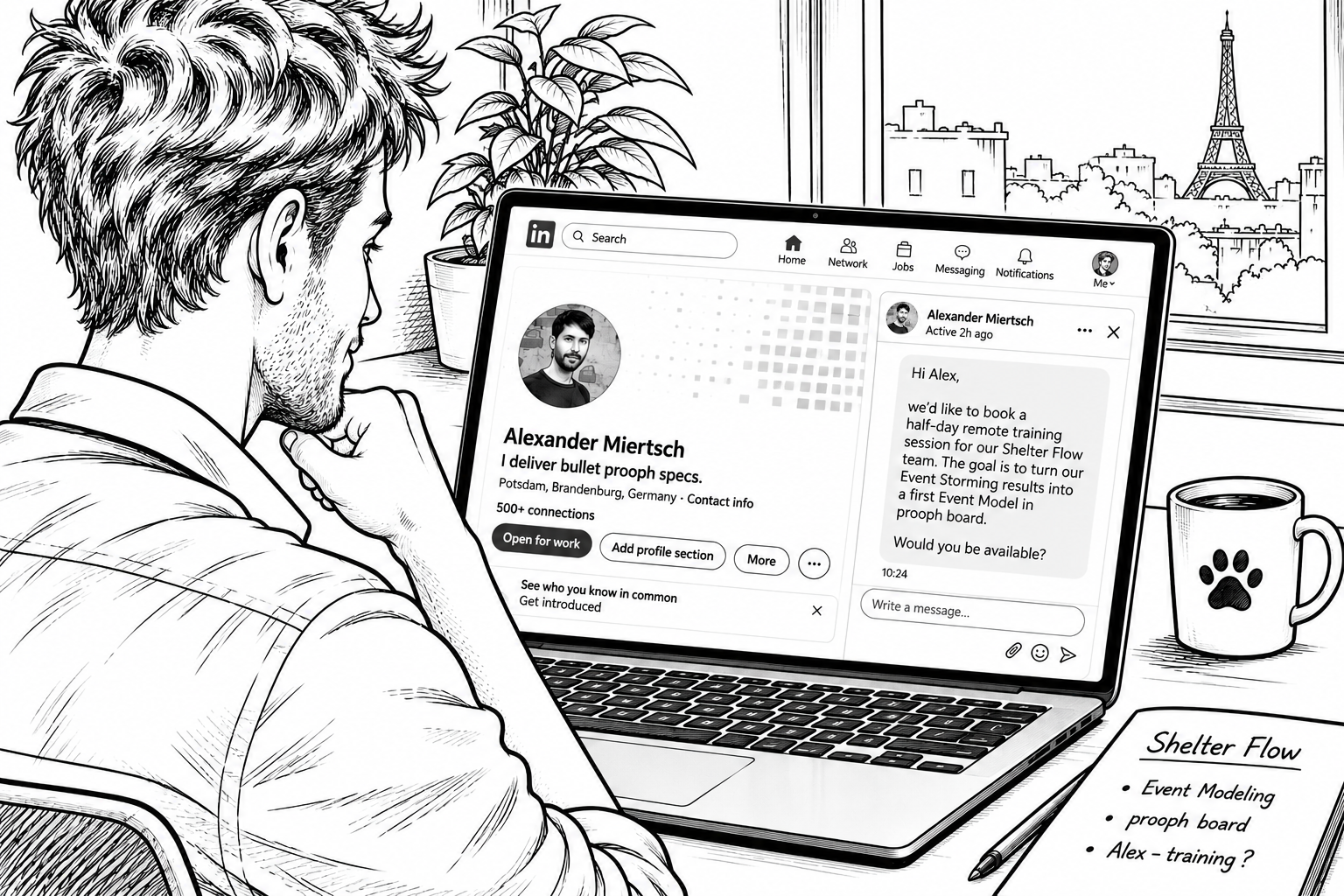
Back at his desk, he opens his messages and finds Alex’s conversation. He starts typing, briefly considers how much context to include, then decides that the workshop results are the best place to begin.
He proposes a half-day remote working session with the team. They want to take what they have discovered about animal intake and develop it into their first Event Model. He asks Alex to help them shape the agenda and guide them through the process, using their own findings rather than a prepared example.
Leon sends the message and looks once more at the workshop photos.
The storm has passed. It is time to start designing.
- Link to Big Picture Event Storming on prooph board. Login required.