8 The Kick-off
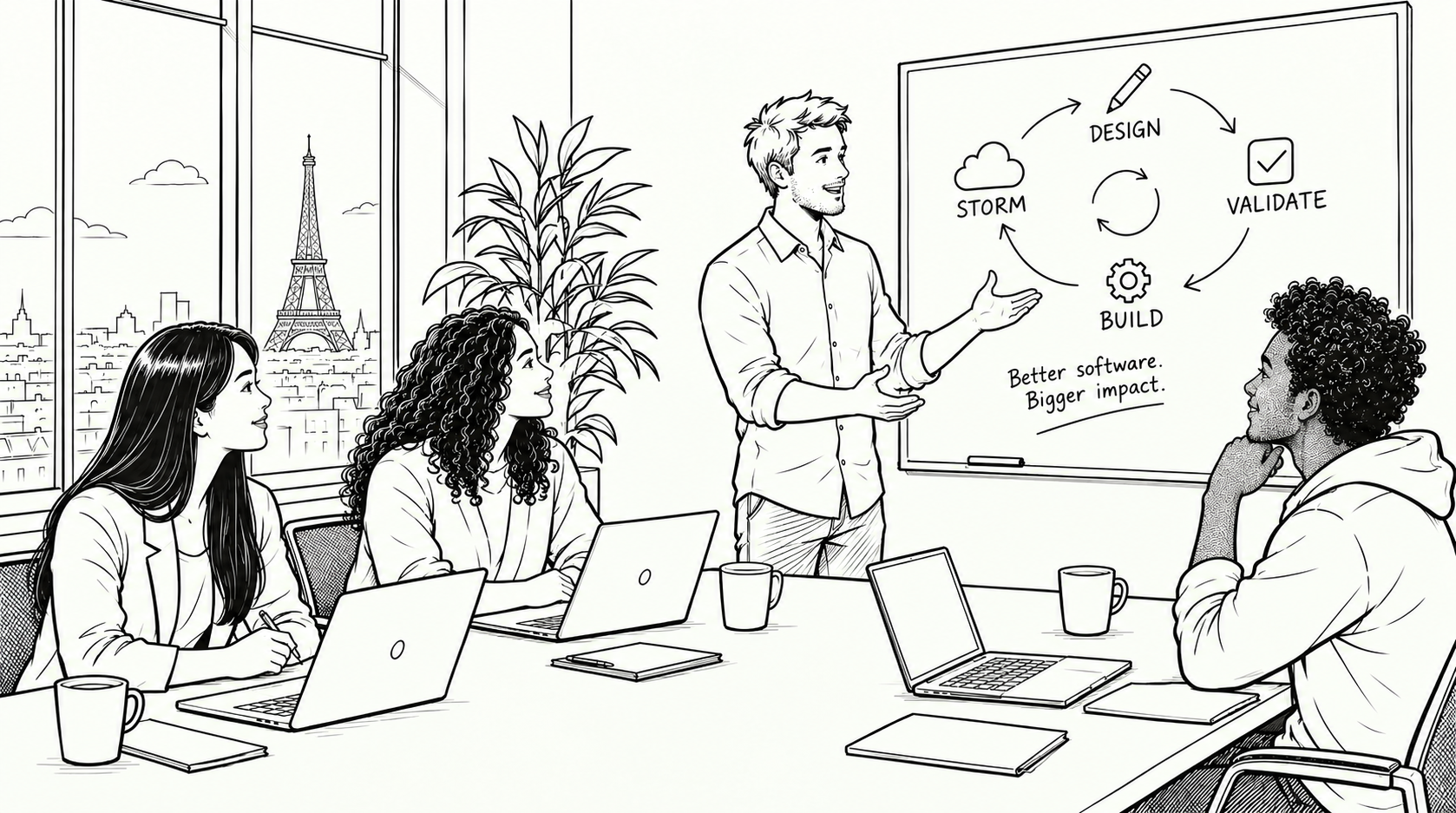
Leon had spent the last few weeks preparing for this meeting. The agreement with Claire is in place, the team had been assembled, and the first appointments were scheduled. He had read about Spec-Driven Development, explored Event Modeling, and spent enough time in prooph board to feel comfortable showing other people around.
The meeting room is ready. Four chairs, a large whiteboard, coffee, and a short presentation. Leon deliberately kept the slides to a minimum. He doesn’t want to spend the first hour explaining a new methodology. They are here to build something, not to attend a seminar.
The first slide shows the project name.
Shelter Flow.
Leon looks around the table. The team is a mix of people who are eager to try something new and people who want to know whether the new thing is actually going to work. Everyone seems happy to leave the familiar routine of ERP development behind for a while.
He takes a breath.
“Okay. Thanks for making the time. As you know, we’re going to build software for animal shelters. But we’re also going to use this project to experiment with a different way of developing software.”
He explains the agreement with Claire. They have three months, and everyone contributes half of their time. At the end of that period, they will sit together, look at what they have built and learned, and decide whether continuing makes sense.
“The three months aren’t a deadline for proving that this approach works. We need to see what happens when we actually try it. If we learn that something doesn’t work for us, that’s useful too.”
He pauses to let that sink in. He doesn’t want anyone to think they are expected to defend a predetermined decision. The experiment is agreed upon. How they conduct it is still open.
Leon draws on the whiteboard. Four words appear in a circle, connected by arrows:
Storm → Design → Validate → Build
8.1 A rough map of how we’ll work
“I’ve been looking into Spec-Driven Development, and one approach that interests me is Event Modeling. The idea is to collaborate on understanding the business and then use that understanding to shape the software we build. Instead of starting with a pile of tickets, we work together on a model of what the system is supposed to do.”
He gestures toward the four words.
“Storm means we explore the domain together. Design is where we work out what the software should do. Validate means we check whether our ideas make sense. And Build is where we turn them into working software.”
The iteration looks neat on the screen. Four words, four steps, arrows pointing in one direction. Leon knows that real work rarely follows such a tidy path, but the sequence gives them somewhere to start.
“And the agents build directly from the model?”
Chris leans forward. The possibility clearly appeals to him.
“That’s the idea. We want the model to become the specification the agents work from. They should get the context they need there, rather than receiving a ticket and having to guess what the rest of the system is supposed to do.”
“That could be really interesting. The agents already write a lot of code. If we can give them better context, maybe they can do much more than just implement individual tickets.”
“Exactly. But we need to find out how much context is enough, and how we make sure the model actually contains what the agents need.”
Leon likes the idea. He also knows that none of them has evidence that it will work in their environment. He doesn’t want their enthusiasm to turn into expectations they cannot meet.
Mina has been listening quietly. She looks at the four words on the whiteboard.
8.2 The questions nobody can answer yet
“What does Validate mean in practice? How do we know that the software the agents build behaves the way we intend?”
It is a fair question. Describing the intended behavior and verifying the implemented behavior are two different problems.
“That’s one of the things we need to work out. We have to find a way to validate what we model and check that the software does what we expect. I don’t have a complete answer yet.”
Mina nods. She isn’t looking for a polished answer. She wants to know whether the team takes the problem seriously. So far, at least, Leon doesn’t pretend to know more than he does.
Kim glances at the whiteboard again.
“Does this include user journeys and interaction design? And how?”
For Kim, that is where the product becomes real. She can imagine a model of business events, but she can’t yet see how it captures the journey a person takes through an application, the decisions they make, or the small details that make an interaction feel natural.
“As far as I understand, yes. But we need to discover together how it works and adjust it to our needs.”
Kim accepts the answer. She trusts Leon’s product judgment, and she is here because she cares about the project. Still, the question remains in the back of her mind. She wants to see how a model that everyone works on can express the details she normally captures in user journeys, designs, and product requirements documents.
Leon moves on. He doesn’t want to turn the first meeting into a debate about artifacts before they have even tried working together.
“I also hope we can avoid translating everything into separate documents before development starts. Ideally, the model gives us a shared place to work out what we mean and provides the agents with the specification they need. But I don’t know how far we can take that. We may discover that we still need other artifacts, or that we need to change how we work.”
He has spent a fair amount of time connecting these ideas in his own head. Now he has to make them useful to people who bring their own responsibilities, habits, and expectations to the project.
And the questions are reasonable. A model that looks convincing to its creator may still leave a designer wondering where the user journey belongs, a developer wondering how to validate the result, and an agent without the information it needs to implement the behavior correctly.
Leon closes the presentation.
“We don’t need to solve all of that today. We need to start working together and see what we discover.”
He opens prooph board and brings up a small model he prepared earlier. A photograph of a dog fills part of the screen.
8.3 Meeting Caramelo
“This is Caramelo. His story is what got me thinking about the project in the first place.”
Leon heard the story from a shelter volunteer. A few weeks ago, while familiarizing himself with prooph board, he sketched its episodes in the tool. The result is not a complete Event Model, and he doesn’t present it as one. It is simply a story that helps them begin to understand the world they are entering.
The episodes touch on things like medical treatment, foster families, and adoption applications. They give the team a few concrete concepts to think about before meeting the people who actually work in a shelter.
“I’d like everyone to read the story before our workshop. Don’t worry about understanding everything yet. It’s there to give us a starting point and some context.”
Chris studies the screen.
“So we get to build something for a good cause, try new technology, and experiment with a different way of working. Sounds pretty good to me.”
“That’s the plan. Though I suspect the difficult part won’t be getting the technology to do something. It’ll be figuring out what we actually want it to do.”
Chris smiles. He doesn’t seem particularly worried about that possibility. For now, the prospect of working with AI agents on a new product is enough to make the project feel different from his regular work.
Leon also tells them that he has contacted Alex, the creator of prooph board. Alex has offered to help if they run into questions and, provided Shelter Flow is open source, to give them additional seats for free.
“Free tools and new technology. We’re off to a good start.”
“Let’s see if we can make good use of them first.”
There is still one important part of the preparation to discuss: the first workshop.
8.4 Preparing for the first workshop
Leon has arranged a full day with Sarah Thompson, the director of the animal shelter. The entire team will participate. They need to understand the work from the people who do it, rather than design a system based on their own assumptions about how a shelter operates.
They are going to try Event Storming, something none of them has used before.
“The basic idea is pretty simple. We get everyone together in front of a wall and write down important things that happen in the business. We write them as events, in the past tense, on sticky notes. Everyone contributes, rather than having one person conduct an interview and take all the notes.”
He has read enough to understand the basic idea. He hasn’t yet experienced what happens when people with different perspectives try to agree on what actually happens in a business.
“We’ll start with Animal Intake. We don’t need to understand the whole shelter in one day. First, we need to understand what happens when an animal arrives and what the people involved need to do.”
Kim looks at the Caramelo story still open on the screen.
“I suppose we’ll find questions we don’t even know to ask yet.”
“I hope so.”
The meeting is nearly over. The team has a project, a rough plan, and a few ideas about how they might work. They also have several questions that nobody can answer yet.
For Leon, that is enough to begin.
Before they meet Sarah, everyone has one small task: read Caramelo’s story. The workshop will start with the work of a real shelter, not with a model the team has already decided is correct.
The experiment is underway.